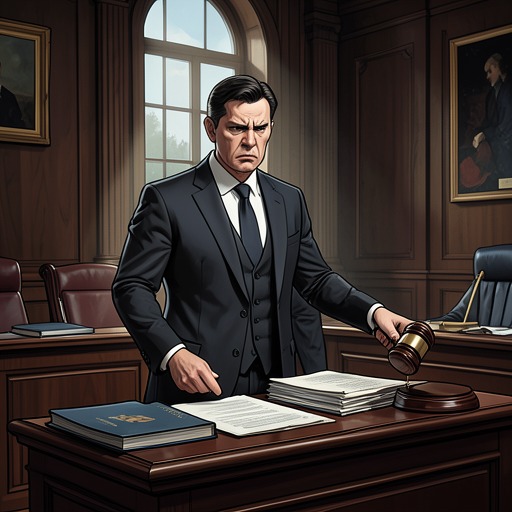
1992, before the Woodson verdict
The Contest of Lies
At the start of his career as a public defender, [Mickey Haller](entity:character-recall-character-mickey-haller-9115341348a9) frames a trial as a contest in which everyone lies and the defense lawyer waits for one falsehood that can be sharpened into a weapon. The principle becomes the method that defines his work: expose the weakness in testimony, even when the client may be guilty.
That year, he is defending [Barnett Woodson](entity:character-recall-character-barnett-woodson-b9ff08d24112), accused of killing two college students whose bodies surfaced in Hollywood Reservoir. The prosecution’s case relies heavily on a jailhouse witness, [Ronald Torrance](entity:character-recall-character-ronald-torrance-149ee01e5413), who claims Woodson confessed.
The fourth day of Woodson’s 1992 trial
Torrance Takes the Stand
Prosecutor [Jerry Vincent](entity:character-recall-character-jerry-vincent-b63d6585b925) calls [Ronald Torrance](entity:character-recall-character-ronald-torrance-149ee01e5413) to testify that Woodson described the murders in detail while they shared a high-security module at [Men’s Central Jail](entity:location-recall-location-men-s-central-jail-8234cb7c7f76). Torrance presents himself as a credible witness, despite his criminal record and the benefits he might gain from helping the prosecution.
Haller lets the direct examination proceed with minimal objection. He wants the jury to see how tightly Vincent controls Torrance’s answers before Haller gives the witness room to explain himself.
During Haller’s cross-examination in 1992
A Witness Cornered
Haller establishes that Torrance met Woodson only weeks before reporting the supposed confession and that Torrance faces serious charges of his own. He also makes Torrance invoke the [Fifth Amendment](entity:rule-recall-rule-cb0d422da9bf) repeatedly when asked about crimes during the riots, weakening the image of a civic-minded informant.
Then Haller asks Torrance to give the confession in Woodson’s exact words. Torrance says Woodson called the victims “niggers” and understood that to mean they were Black, contradicting the fact that the murdered students were white.
Moments later in the 1992 trial
The Orange File
Haller places Woodson’s orange legal file before Torrance. The witness admits he had seen Woodson with the file but insists he never looked inside; when asked to inspect it, he cannot read the documents and describes photographs of two Black victims who are plainly not the victims in the case.
The contradiction exposes how Torrance learned details of the crime and makes his alleged confession untenable. [Judge Companioni](entity:character-recall-character-judge-companioni-234e83571f74) admits the file, and Vincent asks for a recess rather than let the cross-examination continue.
After the jury leaves in the 1992 trial
The Deal Refused
Woodson privately blurts out that he killed the two white students, then complains that the state used a liar against him. Haller rebukes him: exposing a false witness has saved Woodson from the death penalty, but it does not make him innocent or entitled to walk free.
Vincent offers a reduced sentence in return for ending the cross-examination. Haller refuses to rescue the prosecutor’s case at his client’s expense and tells Woodson to take his chances at trial.
After the 1992 trial
Woodson’s Acquittal
The case ends in an acquittal, a professional humiliation that effectively closes Vincent’s path as a prosecutor. Woodson leaves court and mocks the media by sarcastically apologizing for getting away with murder.
Haller later learns that Woodson is killed in a drive-by about two months after the verdict. Vincent, meanwhile, turns to private defense work and eventually thanks Haller for having shown him the financial possibilities of the other side.
May 2, 2007, before dawn
Eli Wyms’s Night in the Park
At [Malibu Creek State Park](entity:location-recall-location-malibu-creek-state-p-67d5bfa0b3a0), [Eli Wyms](entity:character-recall-character-eli-wyms-d5eccaba61bc), drunk and distraught after his wife throws him out, fires repeatedly into the darkness. He says he believes he is shooting at coyotes; one shot destroys a patrol-car spotlight, and the incident becomes a prolonged standoff with sheriff’s deputies.
Wyms finally passes out after demanding a six-pack in exchange for his rifle. Deputies arrest him without firing a shot and transport him downtown in the [4-alpha patrol car](entity:object-recall-object-4-alpha-patrol-car-2c48b429ef08), with his hands cuffed behind his back.
May 2, 2007, late morning
The Malibu Murders
[Walter Elliot](entity:character-recall-character-walter-elliot-a57472bf1d98) arrives at his [Malibu](entity:location-recall-location-malibu-60c95425040a) beach house and finds his wife, [Mitzi Elliot](entity:character-recall-character-mitzi-elliot-2d26364a9111), and her lover, [Johan Rilz](entity:character-recall-character-johan-rilz-e0132244b74f), shot dead. The couple lie in a stark white bedroom, and the killings appear to have been carried out at close range with a powerful revolver.
Elliot says he came to confront his wife, not to kill her. He leaves, returns, calls 911, and waits outside for deputies, setting in motion an investigation that will quickly focus on him.
May 2, 2007, afternoon and evening
Elliot’s Arrest
The first deputies handcuff Elliot and place him in the rear seat of their patrol car while they secure the scene, though they say he is not under arrest. Homicide investigators later interview him, obtain a gunshot-residue test, and find elevated residue on his hands and clothing.
After Elliot declines further questioning, investigators arrest him for the double murder. The missing revolver, the residue result, and his wife’s affair become central parts of the case against him.
After the May 2, 2007 arrest
Elliot Retains Vincent
Elliot’s personal attorney brings in [Jerry Vincent](entity:character-recall-character-jerry-vincent-b63d6585b925), a fellow law-school alumnus, to defend him. Elliot has the means to assemble an expensive defense, but insists that one lawyer, not a visible dream team, represent him in court and before the public.
He secures extraordinary bail by pledging real estate, including the house where the murders occurred. A later unauthorized trip to a New York film festival leads to a bail revocation, but [Mary Townes Holder](entity:character-recall-character-mary-townes-holder-390b4d1e730d) grants an emergency stay and orders Elliot to wear an ankle monitor.
The year before Vincent’s death
Haller’s Recovery
After being shot in an earlier case, [Mickey Haller](entity:character-recall-character-mickey-haller-9115341348a9) returns to work too quickly and suffers painful complications from surgery. During the same difficult period, opioid dependence pulls him away from practice, and he eventually enters rehabilitation before taking a year-long sabbatical.
Haller is sober but still rebuilding his health, his work, and his family relationships when the novel’s present-day crisis begins. He has been preparing to return gradually, with no active cases and no certainty that he is ready.
About five months before the Elliot trial
Vincent’s Jury Fix
Someone approaches Vincent with an offer to place a favorable juror in Elliot’s future trial. The arrangement requires the trial to remain on schedule so the planted juror will be drawn into the correct jury pool and survive selection.
Elliot and Vincent accept. Elliot later says Vincent routes a hundred thousand dollars from the legal fees toward the scheme, with further payments promised for a hung jury or an acquittal.
Several months before Vincent’s murder
Vincent Takes the Wyms Case
Rather than accept [Eli Wyms](entity:character-recall-character-eli-wyms-d5eccaba61bc) as a routine referral from the public defender, Vincent goes to the jail and persuades him to sign on. He then seeks a competency evaluation, sending Wyms to [Camarillo State Hospital](entity:location-recall-location-camarillo-49971de196b0) for a lengthy assessment.
The move makes little sense as ordinary defense work: Wyms’s case appears headed toward a plea, and the hospital stay prolongs it. Vincent’s unusual interest later proves to be part of his covert effort to uncover a defense for Elliot.
The night before the novel’s 2007 present
The Missing Calendar
Vincent works late in his downtown office, as he routinely does on Mondays, and leaves for the parking garage with his briefcase. A killer shoots him twice in the head at close range, takes his briefcase, laptop, phone, and calendar, and leaves no shell casings behind.
The stolen materials contain the practical map of Vincent’s work and may conceal the reason he was killed. Detectives from Robbery-Homicide begin investigating while the office and garage remain crime scenes.
The morning after Vincent’s murder
Haller Gets the Call
[Lorna Taylor](entity:character-recall-character-lorna-taylor-3fc14603777a) tells Haller that Chief Judge [Mary Townes Holder](entity:character-recall-character-mary-townes-holder-390b4d1e730d) wants him in chambers immediately. There he learns that Vincent has been murdered and that an old legal provision names Haller as the successor to Vincent’s practice if he dies or becomes incapacitated.
Holder checks Haller’s fitness, including his year away from the law, then signs an order transferring the practice to him. Haller is suddenly responsible for dozens of cases, including the high-profile Elliot defense scheduled to begin jury selection in nine days.
The same afternoon
Bosch at the Office
Haller reaches Vincent’s office and finds the receptionist, Wren Williams, distressed and resistant to the transfer. He also discovers [Harry Bosch](entity:character-recall-character-harry-bosch-da60c772a3bc) and another detective searching privileged case files for a motive and a suspect.
Haller uses the court order to force the detectives out, insisting that the clients’ confidential files cannot be treated as an extension of the garage crime scene. Bosch warns him that Vincent likely knew his killer and that the danger may lie among the clients.
The afternoon after Vincent’s murder
Rebuilding the Practice
With the computer and hard-copy calendar gone, Haller, [Lorna](entity:character-recall-character-lorna-eb680e7b167e), and [Dennis Wojciechowski](entity:character-recall-character-dennis-wojciechowsk-f050f53b792e) reconstruct the active caseload from the files. They find thirty-one cases, uneven trust-account balances, delinquent clients, and a major fee advance from Elliot.
Haller plans to retain only the cases he can responsibly handle and begins assigning work to Lorna and [Cisco](entity:character-recall-character-cisco-f7172483ae39). The inherited practice is both a professional lifeline and a crushing workload for a lawyer only just back from recovery.
The afternoon after Vincent’s murder
Haller Meets Bosch
Haller returns to the courthouse and later meets Bosch outside [Parker Center](entity:location-recall-location-parker-center-4589bf659ba3). He proposes reviewing Vincent’s files himself and giving Bosch a list of documented threats, a compromise meant to aid the investigation without surrendering privileged records.
Bosch is skeptical and presses for information about active cases. Their exchange establishes the uneasy terms of a partnership: the detective wants the truth, while Haller must protect clients and himself from disclosing what the law shields.
The following morning
The Threat List
Haller gives Bosch eleven names drawn from closed files in which clients threatened Vincent. Bosch quickly dismisses the list as mostly stale leads and makes clear that he is more interested in what Vincent may have discovered in his current cases.
Bosch reveals that Vincent received several short calls from the FBI shortly before his death. Haller confirms that Vincent had no federal cases, leaving both men to wonder whether Vincent was being pressured over a corruption inquiry.
The first two days after Vincent’s murder
The First Client Visits
Haller and [Cisco](entity:character-recall-character-cisco-f7172483ae39) visit Vincent’s clients, keeping some and returning files to others. Haller secures Elliot as a client after promising he can proceed on the existing trial schedule, despite his own need for more preparation time.
Haller also meets [Patrick Henson](entity:character-recall-character-patrick-henson-950179617066), a young surfer who has completed rehabilitation but is homeless, broke, and living in his car. Haller hires him as a driver, offering wages and credit toward his legal fees.
The next morning, on the drive to Malibu
A Chance for Henson
Haller questions Henson about stealing a diamond necklace to fund his opioid addiction. He learns that the necklace’s stated value may be inflated and that its owner’s politically connected husband could be embarrassed if the stones prove false.
Haller files a motion seeking an independent appraisal, turning a seemingly hopeless theft case into leverage. He also shares a photograph from his own worst period of addiction, using honesty about his past to encourage Henson to remain sober.
The day after Haller takes Elliot’s case
The Crime Scene Map
Haller visits Elliot’s [Malibu](entity:location-recall-location-malibu-60c95425040a) beach house with [Nina Albrecht](entity:character-recall-character-nina-albrecht-ee52de20c7e9) and studies the bedroom, blood evidence, doors, and view. The ocean noise suggests that open deck doors could have masked an intruder, undermining the investigators’ claim that Rilz heard someone enter.
Henson explains the cove’s powerful current, which could have carried the missing gun out to sea. Haller sees a way to create doubt, though the scene also reinforces how little he yet knows about what actually happened.
That evening
The Elliot Strategy Session
Haller moves his first serious meeting with Elliot to a neutral boardroom and insists their conversation be private. He explains that the prosecution has motive and opportunity but little physical evidence beyond the residue test, and that the defense needs an affirmative theory rather than only attacks on the state’s case.
Elliot insists he is innocent and wants to testify, while resisting Haller’s advice and rejecting a jury consultant. Haller senses that Elliot is unusually confident and is withholding a crucial part of the story.
Thursday, during Haller’s first week back
The Wyms Hearing
Haller discovers an unlisted hearing for [Eli Wyms](entity:character-recall-character-eli-wyms-d5eccaba61bc), whose case file is missing with Vincent’s briefcase. The prosecutor, [Joanne Giorgetti](entity:character-recall-character-joanne-giorgetti-a5128afa84a7), provides replacement discovery, revealing a case that appears to call for a plea rather than a complicated trial.
Wyms is still heavily medicated after his evaluation at Camarillo. Haller secures a continuance and asks that the drugs be halted so he can communicate with his client, then learns Vincent personally sought Wyms out and kept him in the case for reasons he never explained.
Later that Thursday
Romero’s Clue
Haller finds [Angel Romero](entity:character-recall-character-angel-romero-6fb88eb3b99e), the public defender who originally represented Wyms. Romero confirms Vincent took the case directly from the jail and recalls Vincent hinting that Wyms had fired a “magic bullet.”
The phrase links Wyms’s case to Elliot’s, where Vincent had promised a decisive defense. Haller returns to the office determined to find what Vincent discovered by keeping the apparently minor case alive.
Late Thursday night
The 4-Alpha Connection
Haller studies the Elliot and Wyms files side by side and spots the same patrol-zone designation on the reports: 4-alpha-1. Elliot had been held, handcuffed, in the same patrol car that transported Wyms after his shooting spree.
[Cisco](entity:character-recall-character-cisco-f7172483ae39) confirms that 4-alpha is the [Malibu](entity:location-recall-location-malibu-60c95425040a) district’s lead patrol car, assigned to priority calls. Vincent had used Wyms’s case to discover a possible source for the gunshot residue on Elliot: the residue could have transferred from the car seat to Elliot’s hands and clothes.
That same night
A Gunman at the Office
Leaving Vincent’s office after hours, Haller sees a man resembling the armed figure in Bosch’s surveillance photo. He runs back inside, retrieves [Cisco](entity:character-recall-character-cisco-f7172483ae39)’s stored gun, and fires into the ceiling when the man tries the office door.
Bosch arrives and tells Haller to stop working alone at night. He admits that Vincent’s murder may involve a bribe and warns that the killer could be returning for something Haller now possesses, but he cannot explain the missing information or the FBI’s role.
The following evening
Bosch’s False Photograph
At dinner, Haller confronts Bosch about the suspicious surveillance image and realizes it was staged to expose a police leak. The supposed gunman was part of Bosch’s ruse, and Bosch also admits he hoped the ploy might frighten information out of Haller.
Haller is furious but agrees to help draw out the real killer. They plan to use a newspaper story to suggest that Haller has learned something dangerous, with Bosch providing protection while the unknown target reacts.
During the first week after his return
Haller’s Family Doubts
Haller picks up his daughter, [Hayley](entity:character-recall-character-hayley-0d67d02269b2), from [Maggie McPherson](entity:character-recall-character-maggie-mcpherson-0264ff4d1a6d) and tries to explain why a defense lawyer’s work matters even when the client may be guilty. Hayley asks why he helps people accused of terrible crimes, and Haller struggles to make his own conviction sound convincing.
Maggie’s concerns about Haller’s recovery and his association with another recovering addict sharpen his sense of how fragile his family life remains. Hayley’s hope that her parents might reunite gives Haller another reason to keep rebuilding trust.
The week before testimony
The Anonymous Jury
Jury selection begins before Judge [James P. Stanton](entity:character-recall-character-james-p-stanton-79a933a1a4b7) with an anonymous panel. Haller uses his old paper-grid method and, against Elliot’s preference, secretly relies on [Julie Favreau](entity:character-recall-character-julie-favreau-a53f39610075) to read jurors’ faces and reactions.
The selection process leaves a lawyer in seat three and several apparently malleable jurors. Haller and Favreau disagree with Elliot over whether to strike juror seven, but Haller ultimately follows Favreau’s reading and removes juror ten instead.
The first day of jury selection
The Times Exclusive
[Jack McEvoy](entity:character-recall-character-jack-mcevoy-6ef9016c7599) presses Haller to honor their information-sharing arrangement. Haller gives the Times reporter an exclusive interview, supplying a sympathetic account of his return and the lost files without revealing the underlying conspiracy.
Bosch expects the article to provoke whoever is behind Vincent’s murder. The story’s eventual publication will become part of the trap, while the judge later warns Haller about its possible effect on the jury.
The first day of testimony in California v. Elliot
Haller’s Opening
The prosecution opens with a forceful account of greed, rage, and murder. Haller answers briefly, portraying the case as smoke and mirrors and promising that the investigation narrowed too soon onto Elliot.
He emphasizes the absent murder weapon and argues that the state’s own evidence will reveal tunnel vision. His aim is not to prove an alternate killer immediately, but to make the jurors question whether the prosecution has proved its case beyond a reasonable doubt.
The first afternoon of testimony
The Deputies’ Account
[Jeffrey Golantz](entity:character-recall-character-jeffrey-golantz-051be7af3857) calls the first responding deputies, who describe Elliot’s calm demeanor and repeated statements that he did not kill the couple. Haller largely holds back, waiting for a witness whose account can expose the contradictions in how Elliot was treated.
On cross-examination, Haller gets rookie Deputy Harber to confirm that Elliot was handcuffed, placed in a locked patrol-car seat, and kept there for about half an hour while officers insisted he was not under arrest. The testimony plants a question about whether the investigation had already treated Elliot as its suspect.
The first two days of testimony
Kinder’s Case for the State
Lead investigator [John Kinder](entity:character-recall-character-john-kinder-b30c458f63fd) presents the crime scene, the marriage’s financial tensions, the prenuptial agreement, and the investigation’s efforts to establish Elliot’s opportunity. The prosecution also plays Elliot’s recorded interview, emphasizing his composed manner and apparent confidence.
Haller watches the jury respond to Kinder’s calm authority and realizes that the investigator is an exceptionally persuasive witness. Elliot, meanwhile, appears distracted by business concerns, deepening Haller’s worry that his client does not understand the danger of a murder trial.
During Haller’s cross-examination of Kinder
The French Connection
Haller challenges Kinder’s timing tests and the absence of the murder weapon, then reveals that [Johan Rilz](entity:character-recall-character-johan-rilz-e0132244b74f) had been a confidential informant for French police in an earlier drug investigation. The information appears in a French newspaper article that the defense found by searching beyond the English-language default.
The judge stops the line of questioning until Haller can verify the report, but the disclosure forces the prosecution to confront a major investigative omission. Rilz’s past gives the defense a new way to argue that he may have had enemies the sheriff’s department never seriously pursued.
The first Monday of the defense phase
The Impostor Discovered
Before Haller can begin his defense, [Judge Stanton](entity:character-recall-character-judge-stanton-5d7e255b4656) reports receiving an anonymous letter warning that juror seven is not who he claims to be. The supposed Lockheed engineer does not appear; the man brought from Lockheed is the genuine Rodney Banglund, who says he never received a jury summons.
The impostor has vanished, and the judge replaces him with an alternate rather than declare a mistrial. Elliot panics because he had been relying on the planted juror, but Haller insists the defense can continue without the scheme.
The first day of the defense case
The Residue Defense
Videographer [Julio Muniz](entity:character-recall-character-julio-muniz-6437e52ef041) shows that the same [4-alpha patrol car](entity:object-recall-object-4-alpha-patrol-car-2c48b429ef08) transported Wyms and later held Elliot, both with their hands cuffed behind their backs. Haller then calls Wyms’s arresting deputy, [Todd Stallworth](entity:character-recall-character-todd-stallworth-44f6fdad78d5), who confirms the overnight transfer and the car’s return to service without a special cleaning.
[Shamiram Arslanian](entity:character-recall-character-shamiram-arslanian-25f54f670a1e) testifies that gunshot residue can transfer through contact and that the residue pattern on Elliot’s hands and clothes is inconsistent with firing a gun. Her explanation gives scientific form to Vincent’s hidden defense and turns the state’s strongest physical evidence into a source of reasonable doubt.
Later that day
The Mannequin Demonstration
Arslanian uses a mannequin and a demonstration to explain why the residue on Elliot’s hands and clothing points to transfer rather than firing. The strongest readings are on his hands, with a steep decline across his jacket and none on the shirt beneath it.
She argues that the pattern is consistent with residue passing from Wyms to the patrol-car seat and then to Elliot. The presentation gives the jury a vivid alternative to the prosecution’s interpretation, though the case remains far from over.
After the defense presentation begins
Vincent’s Hidden Purpose
Haller’s investigation shows that Vincent kept Wyms’s case alive not to pursue an ordinary defense, but to investigate the patrol car connection without alerting the prosecution. Wyms’s long competency evaluation gave Vincent time to develop the residue-transfer theory for Elliot.
The discovery reveals the cost of Vincent’s strategy: Wyms endured months of unnecessary delay and medication so the high-profile client could gain a defense. Haller adopts the useful evidence while recognizing the ethically dubious way it was obtained.
After the first week of trial
Elliot’s Confession
After Haller demands that Elliot finally tell him the whole story, Elliot admits at dinner that he and Vincent paid for a sleeper juror. He says the trial had to stay on schedule because the planted juror was tied to the selected jury pool, and that Vincent later wanted a continuance after finding a stronger defense.
Elliot then reveals that his [Florida](entity:location-recall-location-florida-1618e1042117) business story was false and that he killed Mitzi and Rilz himself. He says he went to the house with his .44 Magnum, shot them in anger, and had an accomplice remove the gun, gloves, and clothing before he called 911.
During the same dinner
A Client’s Threat
Elliot says the killings were ordered by a criminal organization for which he had served as a front man, and warns that he will be killed if convicted. He claims the organization still needs him because he controls its money and legitimate holdings.
He also warns Haller that the disclosures must remain confidential and that knowledge of the scheme could get the lawyer killed. Haller leaves dinner bound by professional obligations but newly aware that both the defense and his own safety are compromised.
During the defense phase, after the residue testimony
The French Captain
Haller brings forward a French police captain to verify Rilz’s past as an informant. The testimony supports the defense’s claim that Rilz had betrayed dangerous people and may have carried enemies into California.
The Rilz family, unwilling to watch the defense attack the dead man’s character, has left the country. Haller uses the evidence to widen the field of possible motives, even though he knows the argument does not absolve Elliot of his own concealed guilt.
During the trial, before the final defense days
The Jury Trap Springs
The anonymous warning about juror seven brings the fraud into the open, and Haller’s investigator, [Cisco](entity:character-recall-character-cisco-f7172483ae39), traces the impostor to [David McSweeney](entity:character-recall-character-david-mcsweeney-9674970d3c48). McSweeney has prior arrests and appears to have falsified the identity and background that allowed him to enter the jury pool.
Haller keeps the inquiry compartmentalized and does not tell Cisco the full reason he suspects a planted juror. The discovery creates a serious danger: the defense has investigated an anonymous juror in defiance of the court’s protections, but it may be the only way to expose the conspiracy.
The night McSweeney disappears from court
An Attempt on Haller
A caller pretending to be a police officer lures Haller to [Fryman Canyon overlook](entity:location-recall-location-fryman-canyon-overlo-38b6280fff1f) by claiming [Elaine Ross](entity:character-recall-character-elaine-ross-82ff72f757e3) has been arrested. A masked gunman emerges from the brush and tries to force Haller over the precipice.
A police and federal surveillance team intervenes before the attacker can kill him. The gunman is unmasked as McSweeney, who has a broken hand and appears to have been sent to silence Haller as the jury scheme collapses.
Immediately after the Fryman Canyon attack
Bosch Reveals the Bureau
Haller demands to know why federal agents are present and learns that the FBI had been investigating corruption in the state courts. Vincent was a person of interest who had refused to cooperate, and the bureau had increased pressure on him before his murder.
Bosch confirms that the gun found near the overlook is the same type used to kill Vincent, but says McSweeney did not kill Elliot and [Nina Albrecht](entity:character-recall-character-nina-albrecht-ee52de20c7e9). The distinctions leave Haller facing a second killer and an unresolved threat even as the first conspiracy begins to unravel.
The same night as the Fryman Canyon attack
Elliot Is Killed
Bosch tells Haller that [Walter Elliot](entity:character-recall-character-walter-elliot-a57472bf1d98) and [Nina Albrecht](entity:character-recall-character-nina-albrecht-ee52de20c7e9) have been shot outside Elliot’s Beverly Hills home. Elliot was killed with a different weapon from Vincent’s, and the investigators believe McSweeney was not responsible.
The murder ends the trial before the jury can decide Elliot’s guilt. Haller is left with the knowledge that his client confessed to killing Mitzi and Rilz, while someone else has delivered a separate, apparently deliberate verdict against Elliot.
The morning after Elliot’s death
The Trial Ends
Haller and [Jeffrey Golantz](entity:character-recall-character-jeffrey-golantz-051be7af3857) return to court beside Elliot’s empty chair. [Judge Stanton](entity:character-recall-character-judge-stanton-5d7e255b4656) tells the jury that the defendant has been murdered and discharges them, formally ending the trial without a verdict.
The victim’s mother applauds the news, and the judge sharply stops the display. Haller declines to ask jurors how they were leaning and slips away from the press, no longer willing to turn the case into publicity or career advancement.
Later that morning
Holder Confronted
Haller visits [Mary Townes Holder](entity:character-recall-character-mary-townes-holder-390b4d1e730d) and announces that he is leaving the practice, then accuses her of being for sale and of arranging the attempt on his life. Her reference to his rehabilitation gives away that she had access to private background information about him.
Haller connects McSweeney to Holder’s husband, [Mitch Lester](entity:character-recall-character-mitch-lester-00874c0cd259), who had represented him in earlier cases, and lays out how Holder could manipulate the jury process. He tells her the FBI has McSweeney and warns that she may soon be prosecuted.
The following Thursday morning
The Federal Indictments
Bosch tells Haller that a federal grand jury has indicted Holder, Lester, McSweeney, [Carlin](entity:character-recall-character-carlin-466ed09b2858), and a jury-office supervisor. The evidence includes phone records, transfers of money, and recordings made by McSweeney, who says he served on several previously fixed juries.
Bosch explains that Carlin brokered the arrangement, delivered Vincent’s money, and alerted Holder when Vincent began to have doubts. Holder then used McSweeney to kill Vincent and later tried to contain the damage; the arrests expose a broader pattern of jury manipulation and judicial corruption.
After the Elliot trial ends
Rilz’s Family Verdict
Bosch explains that Beverly Hills detectives suspect [Johan Rilz](entity:character-recall-character-johan-rilz-e0132244b74f)’s family arranged Elliot and [Nina Albrecht](entity:character-recall-character-nina-albrecht-ee52de20c7e9)’s killings. Ballistics link the bullets to a German-made Mauser, and the weapon appears to have been chosen as a message from Rilz’s family’s homeland.
The case is unlikely to produce an arrest: the family has returned to [Germany](entity:location-recall-location-germany-2e3723c2f347), and the hit appears to have been carried out cleanly. Haller recognizes that the killings are a private answer to violence and betrayal, beyond the official case against McSweeney.
The final morning
Brothers on the Mountain
Bosch and Haller talk on Haller’s deck after the arrests. Haller recognizes Bosch as his half-brother, remembering their father’s print of [The Garden of Earthly Delights](entity:object-recall-object-a1cfb4d37c23) and the lesson about the painter’s name; Bosch says he once visited their dying father and told him he had made it through.
They acknowledge that they have lived on opposite sides of the same mountain, one as a detective and the other as a defense lawyer. Haller says he may quit the law, while Bosch answers that he once quit too and returned; their relationship is newly revealed but still awkward and uncertain.
The novel’s final scene
Pancakes as a Beginning
After Bosch leaves, Haller stands with [Hayley](entity:character-recall-character-hayley-0d67d02269b2) and tells her that the detective was a friend. She wishes Maggie had stayed with them the previous night, and Haller answers that they managed to share pancakes, treating the small family moment as a beginning rather than a solution.
He takes Hayley to school as the sun rises over the Pacific. The case has ended without a trial verdict, but Haller turns toward his daughter and the fragile possibility of repairing the life he nearly abandoned.